Sunday, 5 April 2015

Neurons


Neurons:
  • have a cell membrane, cytoplasm, mitochondria, and a nucleus. 
  • have specialized cell structure that enable them to transmit nerve impulses.
  • different shapes and sizes.
  • common features: dendrites, a cell body, am axon, and branching ends.
- Dendrites:
  • short, branching terminals that receive nerve impulses from other neurons or sensory receptors, and relay the impulse to the cell body.
  • numerous and highly branched: increases the surface area
- Cell body:
  • contains the nucleus and is the site of the cell's metabolic reactions.
  • processes input from the dendrites.
- Axon:
  • conducts impulses away from the cell body.
  • ranges from 1mm-1m.
  • In order to communicate with the nearby neurons, glands or muscles, axon terminal releases chemical signals into the space between it and the receptors or dendrites.
- Myelin Sheath:
  • fatty insulating layer of some neurons.
  • gives the axons white appearance.
  • protects neurons and speeds the rate of nerve impulse transmission.
- Schwann Cells:
glial cell, from myelin by wrapping themselves around axon.

Types of Neurons (Classified Structurally)

Types of Neurons (Classified Functionally)
Reflect Arc:
  • Moves directly to and from  brain or spinal cord before the brain centres involved with voluntary control have time to process the sensory information.

- Reflex arcs: 
  • Simple connections of neurons that result in reflexive behaviours.
- Reflexes:
  • Involuntary responses to certain stimuli.
  • must have input.
  • very rapid.


Sunday, 1 March 2015

Translation

Act I: Initiation

  • The mRNA comes to the cytoplasm, with a starting codon AUG.
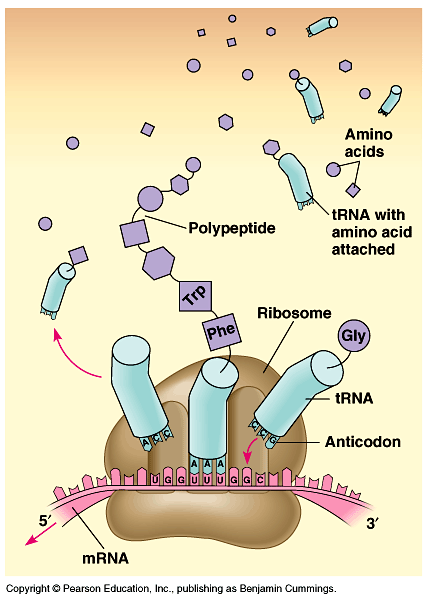
  • A small ribosomal subunit binds to mRNA. The ribosome has two ribosomal units (small and large). 
  • The first tRNA carrying a specific amino acid, met, at one end and having a specific nucleotide triplet, anticodon, UAC, at the other end comes to bind to the starting codon.
  • The ribosome also has one site for binding of mRNA and three sites for the binding of tRNA (P site, A site, E site).


  1. A site: new tRNA with next amino acid to be added to the chain.
  2. P site: holds growing polypeptide chain.
  3. E site: discharged tRNA which will return to cytoplasm and pick up designated amino acid.


  • Initiation factors brings the large ribosomal subunit to mRNA, placing the tRNA in the P site.


Act II: Elongation

  • Another tRNA carrying amino acid recognizes its corresponding codon at the A site.
  • An RNA molecule catalyzes the formation of a peptide bond between the polypeptide in the P site with the new amino acid in the A site.
  • The polypeptide chain is transferred to the tRNA at the A site.
  • The ribosome moves the tRNA with the attached polypeptide from the A site to the P site. This process need energy provided by GTP.
  • The first tRNA enters the E site, and as the third tRNA attaches to the A site, it exits the E site to the cytoplasm to pick another amino acid.


Act III: Termination

  • When one of the three stop codons UAG, UAA, UGA reaches the A site, a release factor cut the bond between the polypeptide chain and its tRNA at the P site.
  • Polypeptide, which is known as protein, is released.
  • Translation complex disassembles.


Transcription

Transcription is the copying of a sequence of DNA to produce a complementary strand of RNA

Act I: Initiation

  • Transcription factors recognize promoter regions (TATA box) on the template and bind to the promoters.
  • This signals RNA polymerase II to bind to transcription factors. Together they form a transcription initiation complex.
  • Polymerase II starts transcription.
Act II: Elongation
  • RNA polymerase unwinds DNA double helix and adds RNA nucleotides to the 3' end of the growing strand. RNA, same as DNA, grows from 5' to 3'.
  • When adding the complimentary nucleotides to the RNA transcript, every thymine is replaced by uracil.
  • As RNA polymerase II moves forward, the double helix behind re-forms, and the newly transcribed RNA molecule, RNA transcript, peels away.
  • The strand that RNA reads is called the template strand/ antisense strand.
  • The strand that has exactly same sequence as RNA is called coding strand/ sense strand.
  • A single gene can be transcribed by multiple polymerase simultaneously.
Act III: Termination
  • Transcription stops when RNA polymerase transcribes as a terminator AAUAA.
  • The pre-mRNA is cut, and RNA polymerase II is released form the DNA.
  • In eukaryotic cells, before the mRNA enter the cytoplasm, enzymes work on modifying them.
  • G-cap (modified guanine) is assed to the 5' end of pre-mRNA.
  • PolyA-tail is added to the 3' end of pre-mRNA.

  • Pre-mRNA combines with snRNPs and other proteins to form a spliceosome.
  • The snRNA in the snRNPs base pair with nucleotides at the end of the noncoding segments on the pre-mRNA, introns.
  • Introns are excised from the pre-mRNA, then the coding regions, exons, are spliced together in the spliceosome.

  • The snRNA acts as a ribozyme, and the RNA acts as an enzyme.
  • The spliceosome comes apart, releasing mRNA.

Sunday, 22 February 2015

DNA Replication


Act I: Initiation
  • Helicase unwinds the double-stranded DNA at locations called replication origins. The structure that is created is known as "replication fork".


  • Single-strand-binding-proteins then help to stabilize the newly unwound single strand, and prevent it from rebinding with its other strand.

  • As the DNA unwinds, tension starts to build up on either sides of the unwound strand. Gyrase then comes in and cuts the two ends to release the tension.
  • An RNA primer is added on to the DNA template strands by the enzyme primase to initiate the DNA replication process.


Act II: Elongation
  • DNA polymerase III starts adding new nucleotides to the end of the RNA primers to create a new DNA daughter strand complementary to the original strand.

  • SInce DNA is antiparallel, the new strands will grow in the opposite direction of each other.
  • Leading strand: synthesized continuously in the 5'->3' direction by polymerase III. Only one RNA primer is needed to initiate the replication.

  • Lagging strand: synthesized discontinuously in the 3'->5' direction by polymerase III. In the lagging strand, the RNA primase adds many RNA primers to form short, discontinuous fragments known as Okazaki fragments.

Act III: Termination
  • Polymerase I comes in and now proofreads the lagging strands and replaces the RNA primers with DNA nucleotides.
  • As a polymerase III reaches a previous RNA coded section, the Okazaki segments are glues together with ligase.


'